Friday, October 28, 2011

Current Event: Drunken Monkey in Stockton!

Drunken Monkey

Today, October 28, 2011, Dr. Robert Dudley from UC Berkeley gave a seminar talk on "The Drunken Monkey: Is Alcoholism in Modern Humans an Evolutionary Hangover?" at the University of the Pacific's Biology Building. The Drunken Monkey hypothesis was first proposed by Dr. Dudley. "The drunken monkey hypothesis proposes that human attraction to ethanol may have a genetic basis due to the high dependence of the primate ancestor of Homo sapiens to fruit as a food source. Ethanol naturally occurs in ripe and overripe fruit and consequently early primates developed a genetically based attraction to the substance" (Wikipedia).


Thursday, October 20, 2011

Sunday, October 16, 2011

Current Event: Confucian Engaged in Youth at Stockton Christian Church


Thursday, October 13, 2011

Popular TV Shows: Dexter in Focus - Bridge Between Confucianism and Legalism

Popular TV Show Character Dexter


When I heard about the Dexter show and the main character, I realized immediately that the Confucian traditions are applicable to the character.  In fact, Dexter follows the code from Xunzi’s (Xunzi was a student of Confucius's grandson) saying of “In the case of incorrigibly evil men, punish them without trying to reform them.” This is exactly how Dexter acts in his actions and how he justifies himself.  For Dexter, the justification he used is called the “The Code.” According to his code, he only kills victims that have killed someone without justifiable cause and will likely commit the crimes again. 


Saturday, October 8, 2011

Current News: Stockton Amtrak Crash!!! Crash at Contra Costa County


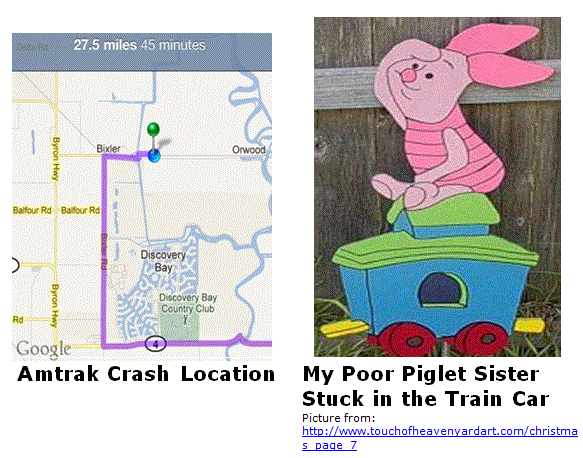
On September 30, 2011 at approximately 7:20 p.m., the train carrying 191 passengers from Oakland to Bakersfield (with stop at Stockton) collided with a truck at a rural crossing east of Brentwood in the Contra Costa County. Majority of the passengers were due to arrive at Stockton Amtrak station at 7:30 p.m. that evening. There were 37 passengers and two crew members that suffered “minor to moderate” injuries. My little sister was one of the passengers inside the train car that collided with the truck and was one of the few passengers in that train car that were unhurt. Almost all the passengers wanted to get off the train immediately but were all told they had to stay on the train. My sister, along with the other passengers, was forced to stay at this crash site for the next five hours. My friends and I drove to the train crash location to try to take my sister and were told that no one was allowed to get off the train by the police officers.

Wednesday, October 5, 2011

Better Leadership: How Confucianism Can Be Used in the Context of a College Fraternity

University of the Pacific--home to the numerous student organizations and activities that are available on the school campus--has an especially large number of fraternity organizations. Most fraternities and large organization clubs, have conflicts and issues among the members. I recommend Confucianism application in a fraternity as the best solution to solve inter-fraternity conflicts I agree with Dr. de Bary that Confucianism is a “life-style and an attitude of mind.”  The Confucian principles can have beneficial effects on a person in all aspects of his or her life. Each member of the fraternity can benefit from the application of Confucianism and the fraternity’s conflicts can be more easily dealt with.

Sunday, October 2, 2011

Culture: Values of family in American Born Asians

Mary and Sarah are second generation Asians (or ABA) who were Pre-Pharm and Pre-Dental majors at the Pacific, respectively. Their families brought them up far away from their homeland (Vietnam & China). For Mary, the Vietnamese culture and language is not even being practiced at home, especially her family are somewhat open-minded about what Mary should do for academics and boyfriend. For Sarah, the Cantonese language is often spoken at home and, in most ways, her mother adheres to the common Asian discipline for Sarah and her sister. They did not choose to study Pre-Pharm or Pre-Dental. For both Mary and Sarah, despite their love for art and talent in art, they chose to study Pre-Pharm and Pre-Dental due to her “ren” or love for her family (parents and younger siblings) and her strong desire to support them in the best way possible after she finished with school. Despite being American born and being second generation with slightly different family upbringing, they act unconsciously with the Confucian principles. They act in such manner because the Confucian virtues are the “natural laws” and what determine the moral society and guide the social order in the Asian societies.

Friday, September 30, 2011

Better Leadership: Why Legalism Should Not be Applied in the Context of a College Fraternity

Legalism, “Fa Jia” or “school of law,” was the utilitarian political philosophy with Han Fei Zi as its major proponent.  The legalists argued that the best government is one based on authoritarian control, not ethical or moral persuasion.  They claimed that human nature was incurably selfish and that people normally do not know what to do.  Thus, the only way to preserve the social order (and society) was to impose strict discipline from above and enforce laws strictly.  For example, if your father or your husband disobeyed the government in a small infraction, such as lying, you were morally obligated to report him to the officials and let the officials punish him.

Saturday, September 24, 2011

Culture: Importance of Confucian Virtues: the Natural Laws in Asian Societies


Dr. Yao, Author of Introduction to Confucianism, wrote in his book that the “Five Regulations” are “five Confucian virtues,” which are “ren” (humanness), “yi” (righteousness), “li” (ritual/propriety), “zhi” (wisdom), “xin” (faithfulness). He claims that these virtues are believed to be as constant and unchanging as natural laws, remaining the same for all time and guiding/ordering all other virtues” (Yao 34).  


Dr. Yao’s sentence here is very powerful and important because it was able to convey effectively the important Confucian virtues that are the glue in Asian societies.  They are the unspoken and accepted laws that guide East Asian societies, even if they are not obvious or invisible at times. 


Thursday, September 22, 2011

What is Confucianism?

“About 2,500 years ago, a man was born to a once aristocratic family in a small state called Lu in East China. During his lifetime, the man endeavored to…carrying forward the old tradition in a chaotic environment and opening up a new horizon in a dark age. By the time he died at the age of seventy-three, his teachings had spread throughout the state and beyond…But there was one thing that neither [his students and disciples] knew: that Chinese culture, and to some extent, East Asian culture, would be forever linked with his name, that the tradition he loved…would rank with the greatest in the world” (Yao – Author of An Introduction to Confucianism). This tradition is Confucianism- the Western English word coined by the Jesuits from the 16th century.